Post-credit scenes: results for “tag: apache”

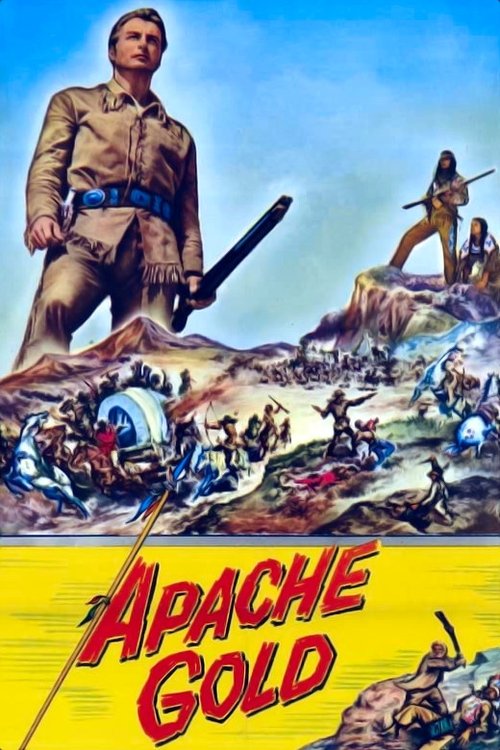
Poster for Apache Gold (1963), awaiting its first vote.

The construction of the Great Western Railroad creates heavy conflict between the railway company and neighboring Indian tribes. Worse, criminal gang leader Santer sets his eyes on a gold mine located on holy Indian land and influences the construction supervisor to re-rout the planned railroad straight through Apache land. Old Shatterhand, who works as a measurement technician, discovers the evil plan and searches contact with the Apaches in an effort to avert war.

Chato's Land (1972) artwork. Still a mystery after the credits.

In 1870s New Mexico, a half-breed kills a bigoted sheriff in self-defense but the posse that eventually hunts him finds itself in dangerous territory.

Poster, Apache (1954). Nobody has voted on this one.

Following the surrender of Geronimo, Massai, the last Apache warrior is captured and scheduled for transportation to a Florida reservation. On the way he manages to escape and heads for his homeland to win back his girl and settle down to grow crops. His pursuers have other ideas though.

Apache on the County Seat (1973): nobody has checked the credits yet.

Hoot is ordered to bring in the Indian Jolly Red Giant for not paying his fine for overpopulating his Indian tribe. Hoot Kloot and Fester makes it to the tribe, but there is no Red Giant around. Hoot inspects the tribe for clues, but the Indians starts shooting arrows. Hoot finds Jolly Red Giant in the desert, but Hoot has hard time making him come, since he's giant...

Apache (1953) poster. The count is still zero.

Short about the daily life of the Apaches, including their ceremonies.

Unconquered: Allan Houser and the Legacy of One Apache Family (2008): nobody has checked the credits yet.

In decades past, Native American artists who wanted to sell to mainstream collectors had little choice but to create predictable, Hollywood-style western scenes. Then came a generation of painters and sculptors led by Allan Houser (or Haozous), a Chiricahua Apache artist with no interest in stereotyped imagery and a belief that his own rich heritage was compatible with modernist ideas and techniques. Narrated by actor Val Kilmer and originally commissioned as part of an exhibit of Houser’s work at the Oklahoma History Center, this program depicts the artist’s tribal ancestry, his rise to regional and national acclaim, and the continuing success of his sons as they expand upon and depart from their father’s achievements. Key works are documented, as is Houser’s tenure at the Santa Fe–based Institute of American Indian Arts.

Privacy policy

When you vote, we save your Yes or No answer and when you voted.

We use a cookie and your internet address to recognize your vote on each movie. This prevents repeat votes. The cookie lasts for five years.

Your votes are kept as part of the movie totals.