

In the mountains, Diotima meets Karl and fall in love and have an affair. Karl's friend Vigo mistakenly believes she's in love with him, causing rifts in all relationships.
In the mountains, Diotima meets Karl and fall in love and have an affair. Karl's friend Vigo mistakenly believes she's in love with him, causing rifts in all relationships.

Record of the 1934 German expedition to Nanga Parbat, led by Willy Merkl and with the full backing of the new Nazi government. Peter Aschenbrenner and Erwin Schneider reached an estimated height of 7,895m on July 6, but were forced to return because of worsening weather. On July 7 they and 14 others were trapped by a ferocious storm at 7,480m. During the desperate retreat that followed, three famous German mountaineers, Uli Wieland, Willo Welzenbach and Merkl himself, and six Sherpas died of exhaustion, exposure and altitude sickness, and several more suffered severe frostbite.

"Bialy Slad" featured as the main characters amateur actors, who were by that time well-known Polish skiers, among them Andrzej, Herr Krzeptowski's brother. The film depicts the story of two orphans, Zoska and Wladek; Zoska is in love with Jasiek, a hunter, but this is an unrequited love because Jasiek loves Hanka, who at the same time is desired by the handsome and strong Andrzej, a mountain climber.
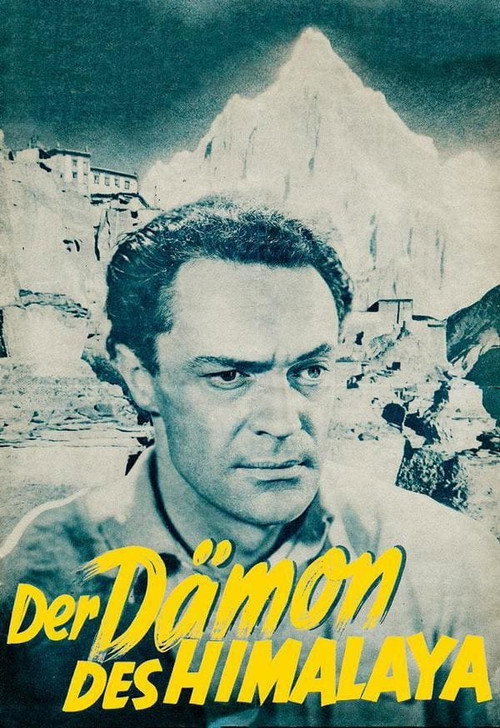
German film about a Himalayan expedition and the search for a mountain spirit, who guarded, according to the tradition of the locals, the peaks of high mountains. The long-lost and recently rediscovered and restored film is now a unique cinematic document because it is the first feature film that was shot directly in the Himalayas (up to 6400 m altitude). Hans Ertl even turned his Bell & Howell to the main summit of Sia Kangri, 7422m. Likewise, the film contains footage from India and Tibet, from a time long before the emergence of mass tourism. Some of the footage was later recycled in ‘Lost horizon’ (1937) by Frank Capra and in ‘Storm over Tibet’ (1952).

The mountain guide Jakob is a controversial figure. His supposed father dies and leaves behind a great heritage to the people. In the town they consider Jakob a bastard, because his parents were not married, which means that without a testament, the lands in which he lives do not belong to him. But the testament indicates that the inheritance corresponds him under a single condition, he must be the first person to climb the east face of Monte Verità. French version of Die weisse majestat, shot the year before in German with the same script in the Eiger/Jungfrau region but with different actors and by a different director.

A travelogue film on the Isle of Skye by Stanley Watson, including some mountaineering and rock climbing. Stanley Watson is a keystone in the history of British climbing. He established the British Mountain Guides organisation in 1930. Watson made the first Britain's complete rock climbing film, High Hazard, in 1935, a film about climbing in the Lakes.

A record of the second British Everest expedition showing the journey from Darjeeling to Tibet, activities of the Tibetans, and the climb itself. The main aim of the 1922 expedition was to make the first ascent of Mount Everest. There are two attempts in May via the North Ridge. The first by Mallory, Morshead, Norton and Somervell is without oxygen and reaches 26,985ft. The second by Geoffrey Bruce and Finch reaches 27,300ft and sets a new altitude record. Captain Noel toured the world with this film, and wherever he went the picture was received enthusiastically. It was the first film of an Everest expedition, and the earliest documentary filmed in Tibet.

Short version of 'Nanga Parbat' (1936), the record of the 1934 German expedition to Nanga Parbat, led by Willy Merkl and with the full backing of the new Nazi government. Peter Aschenbrenner and Erwin Schneider reached an estimated height of 7,895m on July 6, but were forced to return because of worsening weather. On July 7 they and 14 others were trapped by a ferocious storm at 7,480m. During the desperate retreat that followed, three famous German mountaineers, Uli Wieland, Willo Welzenbach and Merkl himself, and six Sherpas died of exhaustion, exposure and altitude sickness, and several more suffered severe frostbite.

Epic documentary about the German expeditions to Nanga Parbat up to 1937. After a first unsuccessful attempt in 1932 and the tragic second expedition led by Willy Merkl in 1934, in 1937 Karl Wien led another expedition to the mountain following the same route as Merkl's expeditions. Progress was made, but more slowly than before due to heavy snowfall. About 14 June seven Germans and nine Sherpas, almost the entire team, were at Camp IV below Rakhiot Peak when it was overrun by an avalanche. All sixteen men died. The film was assembled in 1938 with rescued 16mm material shot during the 1937 attempt and footage from the previous expeditions.
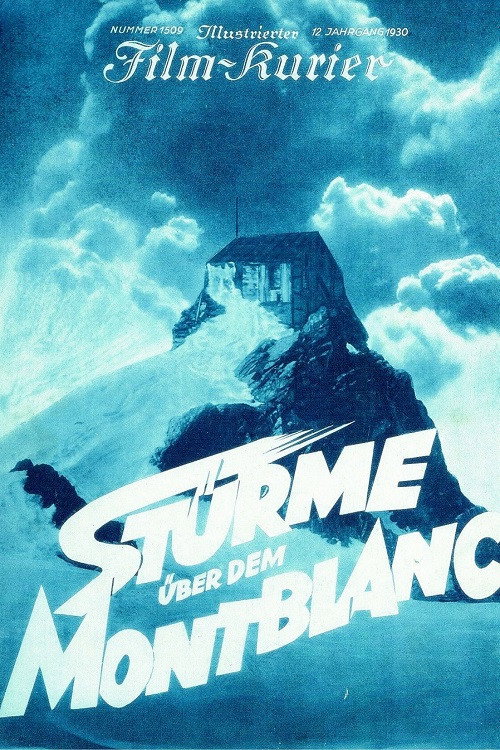
Hannes is employed at the Mont Blanc Observatory; the only outside connection is a pilot and Hella over the radio. Hella ascends the mountain but her father dies along the way.

Record of the 1937 German Expedition to Nanga Parbat, led by Karl Wien. This was the third German expedition to the mountain, and the team followed the same route than the 1932 and 1934 expeditions, led by Willy Merkl by the Rakhiot Face. During the ascent, progress was made, but more slowly than previous expeditions due to heavy snowfalls. Sometime between 14 and 16 June, Wien was camped with other six German climbers and nine Sherpas at Camp IV, below Rakhiot Peak, when it was overwhelmed by a massive avalanche. All sixteen men were killed in what remains as the worst single disaster ever to occur on an eight thousand meter peak. Uli Luft, Carl Troll and Dawa Thondup, who stood at the base camp, were the only survivors of the German and Sherpa teams respectively. The film shows images of the members of the rescue team, led by Paul Bauer, that arrived one month later.

Following in the footsteps of Captain John Noel and his immensely popular documentaries taken on the Mount Everest expeditions of the 1920s ("Climbing Mount Everest"/"The Epic of Everest"), Frank Smythe hoped to help finance his 1931 attempt on Kamet, another Himalayan peak, by bringing back film footage of a successful ascent including summit shots which were at that time the highest ever taken in the world.

Record of the Japanese expedition to Nanda Kot (6861m) in Himalaya in 1936. The expedition was organized by the Mountaineering Club of the Rikkyo University and included Sakuta Takebushi, who had represented Japan at the Olympic Games. They were the first to climb the mountain and carried a camera to the summit. Six party members made it all the way to the top, using all-Japanese gear. The party, without previous Himalayan experience, had been training in in the Japanese Alps in winter conditions.

Percy Wyn-Harris' filmic record of the 1933 expedition, led by Hugh Ruttledge. It features comprehensive footage of the 1933 Mount Everest Expedition. Opens on the team’s arrival in India and shows landmarks, then shots of the preparations in Darjeeling. Includes blessing ceremonies by the Buddhist Lama at Darjeeling and the Chief Lama at Rongbuk. Scenes of all six camps being established and the journey back to Darjeeling, when it became clear summiting would be impossible this time.

Sounded version of the 1928 film 'Der Kampf ums Matterhorn'. The added sound track included music composed by Schmidt-Boelckeb and dubbed dialogs by different actors. This version is slightly shorter than the silent film due to the disappearance of the movie titles. The story, based on the novel by Carl Haensel recreates the struggle between Edward Whymper and Jean-Antoine Carrel for the first successful ascent of the Matterhorn in 1865. In 1938 two new versions of the movie were filmed under the direction of Luis Trenker, who acted again in the role of Carrel. One version was shot in German (Der Berg ruft) and the other in English (The Challenge).
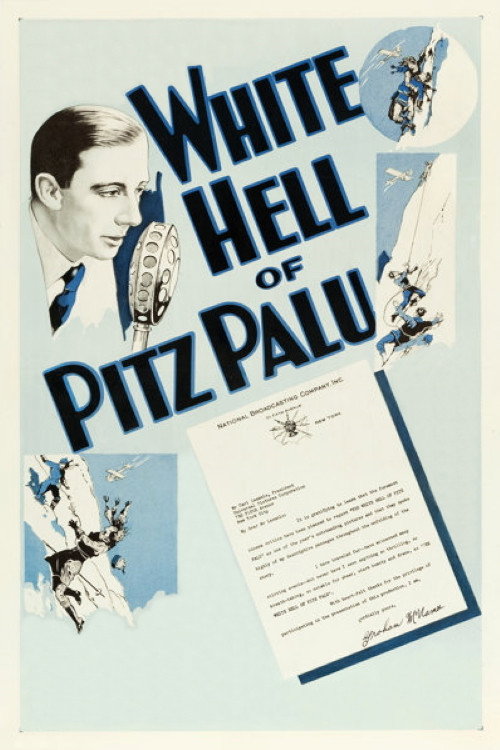
Dr. Johannes Krafft climbs a 12,000-foot mountain over and over again to search for his wife, who was lost on their honeymoon. Another couple makes the dangerous climb with him.

English-language, dubbed sound and partly re-edited version of Der Kampf ums Matterhorn. During an early, unsuccessful attempt at climbing the Matterhorn, Edward Whymper finds himself rescued by an italian guide, Jean Antoine Carrel. The two men quickly build a friendship and agree to reach the peak together. However, local villagers plot to divide the alliance of Whymper and Carrel and both men join rival teams as they set out in a race to conquer the mountain. A mountaineering drama based on the novel by Carl Haensel and inspired in the dramatic true story of Edward Whymper, who led the first successful ascent of the Matterhorn in 1865.
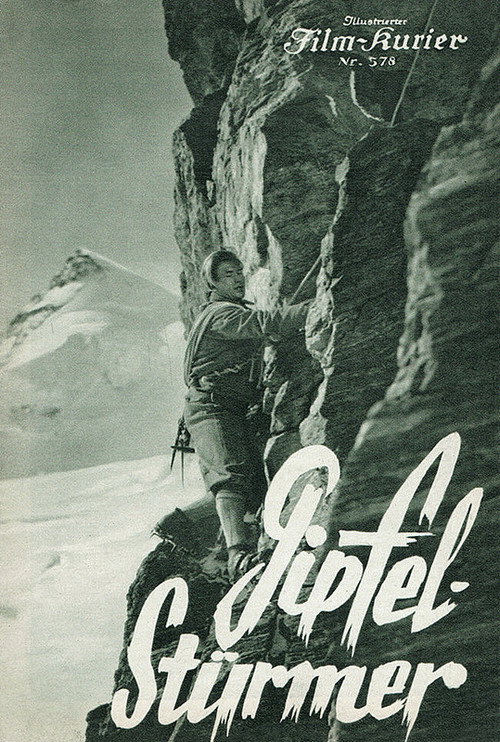
The two unemployed engineers Franzl and Bertl want to be the first to climb the Matterhorn from the dangerous north face. They travel by bicycle with Mizzl and Traudl but without telling them about their intentions. The women accompany them on the assumption that it is a touristical trip. All four camp in a tent at the foot of the Matterhorn and Franzl and Bertl secretly begin the dangerous ascent. The girls will have to follow the ascent together with the residents of the village and the guests of the mountain hotel using binoculars. The role of Franzl is played by Franz Schmid, the actual conqueror of the north face of the Matterhorn together with his brother Toni in 1931.


Record of the 1936 British Mount Everest Expedition led by Hugh Ruttledge. Although the North Col was reached, a combination of high winds, storms and waist-deep snow made progress above 7,000m difficult and, with the monsoon arriving early, Ruttledge called off the expedition. Members of the expedition were mountaineers Eric Shipton, Frank Smythe, Percy Wyn-Harris, Edwin Kempson, Dr. Charles Warren, Edmund Wigram, Peter Oliver and James Gavin. The party also included Tenzing Norgay. This was a very well-equipped expedition, which included oxygen and radio equipment.