Post-credit scenes: results for “tag: counterfeit”

Poster for The Castle of Cagliostro (1979), blank on post-credit scenes.

After a successful robbery leaves famed thief Lupin the Third and his partner Jigen with nothing but a large amount of expertly crafted counterfeit bills, he decides to track down the forgers responsible—and steal any other treasures he may find in the Castle of Cagliostro, including the 'damsel in distress' he finds imprisoned there.

Cover image for Queenpins (2021), not yet voted on.

Bored and frustrated suburban homemaker Connie and her best pal JoJo, a vlogger with dreams, turn a hobby into a multi-million-dollar counterfeit coupon caper. After firing off a letter to the conglomerate behind a box of cereal gone stale, and receiving an apology along with dozens of freebies, the duo hatch an illegal coupon club scheme that scams millions from mega-corporations and delivers deals to legions of fellow coupon clippers. On the trail to total coupon dominance, a hapless Loss Prevention Officer from the local supermarket chain joins forces with a determined U.S. Postal Inspector in hot pursuit of these newly minted “Queenpins” of pink collar crime.

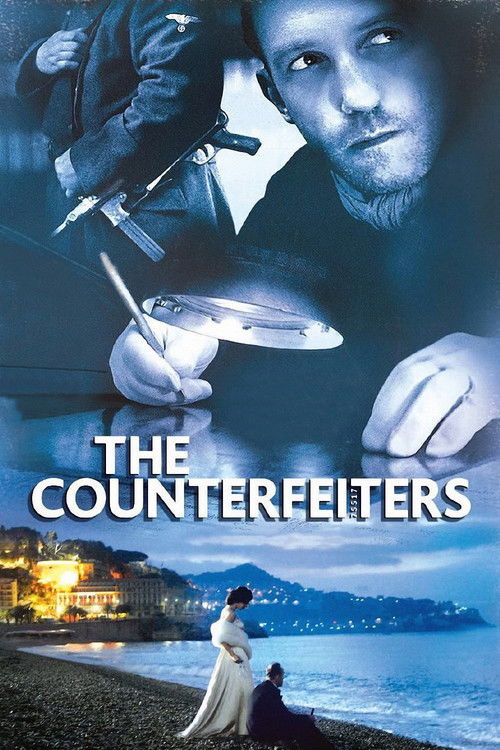
Poster for The Counterfeiters (2007), awaiting its first vote.

The story of Jewish counterfeiter Salomon Sorowitsch, who was coerced into assisting the Nazi operation of the Sachsenhausen concentration camp during World War II.

Film poster, Kounterfeit (1996). No post-credit verdict yet.

Flush with $3 million in counterfeit bills, a pair of small-time criminals hope to make the big time by trading it in for a cool million in authentic cash. However, when the trade goes awry, three men end up murdered- one a cop with a vengeful sister--and the hapless buddies find themselves caught between the police and mob hit men after the money.

Movie art for Trapped (1949), post-credit scene unknown.

Secret Service agents make a deal with a counterfeiting inmate to be released on early parole if he will help them recover some bogus moneymaking plates, but he plans to double-cross them.

Poster art for The Counterfeiters of Paris (1961), an open question on post-credit scenes.

"Le Dabe" retired many years ago and now he lives in the Tropics where he owns stables and horses. He is a very rich man. He was the king of all money counterfeiters. He is contacted from Paris to organize a new job. He says no. But when he finds out the the currency that should be counterfeited is the Dutch florin, he accepts immediately. He retired after having counterfeited 100 florin notes just before the Queen Wilhelmina retired them from circulation. He flies to Paris. But the gang is not to be trusted, at least not all of them.

Movie poster for Frozen Land (2005), waiting for its first vote.

When a schoolteacher is sacked, he projects his bad mood at his troubled teenage son. The son, in turn, buys a CD player from a pawnshop with counterfeit money. This starts a chain reaction of misery as every victim projects his problems on to another person.

Cover image for Dr. Mabuse, the Gambler (1922), not yet voted on.

Dr. Mabuse and his organization of criminals are in the process of completing their latest scheme, a theft of information that will allow Mabuse to make huge profits on the stock exchange. Afterwards, Mabuse disguises himself and attends the Folies Bergères show, where Cara Carozza, the main attraction of the show, passes him information on Mabuse's next intended victim, the young millionaire Edgar Hull. Mabuse then uses psychic manipulation to lure Hull into a card game where he loses heavily. When Police Commissioner von Wenk begins an investigation of this mysterious crime spree, he has little to go on, and he needs to find someone who can help him.

Seoul Raiders (2005): nobody has checked the credits yet.

Agent Lam (Tony Leung) sets out to track a pair of plates used to make fake American dollars. When he discovers the plates, they are conned out of him by enigmatic US Embassy workers Owen (Richie Ren) and JJ (Shu Qi). With the trail now leading to Korea, Lam sets off in hot pursuit. There, amidst the dangerous and glamorous urban landscape of Seoul, Lam finds himself confronting an underworld crime boss known as the Polar Bear, head of the biggest counterfeiting organisation in Asia.

Film artwork for Dude Cowboy (1941), no verdict on the credits.

A Nevada rancher goes undercover for the U. S. Secret Service to help capture a gang of counterfeiters. Director David Howard's 1941 B-western stars Tim Holt, Marjorie Reynolds, Lee White, Eddie Kane, Ray Whitley, Helen Holmes, Glenn Strange, Byron Foulger, Eddie Dew, Tom London and Hank Worden.

Poster for The Gardener of Argenteuil (1966), awaiting its first vote.

Tulipe, is an old man who lives alone in an old railway carriage in the Argentueil region of Paris. His main passions are gardening and oil painting, but he also has a secret source of income. His godson discovers that Tulipe is actually a master forger, producing perfect copies of 10 franc notes. His godson’s girlfriend sees this as an opportunity to get very rich – but she must persuade Tulipe to forge 500 franc notes. Assuming Tulipe’s agreement, his godson and his girlfriend buy an expensive new car and luxury villa in provincial France – but there is a cruel turn of fate in store for them when Tulipe strikes up a friendship with a millionaire playboy.

Image for The Big Shakedown (1934), a film with no post-credit data.

Former bootlegger Dutch Barnes pressures neighborhood druggist Jimmy Morrell into making cut-rate knockoff toiletry, cosmetic, and pharmaceutical products.

The Match King (1932). Nobody has said whether there is anything after the credits.

Unscrupulous Chicago janitor Paul Kroll uses deceit to fund a return trip to his homeland of Sweden. There, via ongoing continuing deceit and manipulation, he gradually attains a monopoly on the matchstick market in several countries and becomes an influential international figure. Based on the true story of Ivar Kreuger.

Privacy policy

When you vote, we save your Yes or No answer and when you voted.

We use a cookie and your internet address to recognize your vote on each movie. This prevents repeat votes. The cookie lasts for five years.

Your votes are kept as part of the movie totals.