Post-credit scenes: results for “tag: geometry”

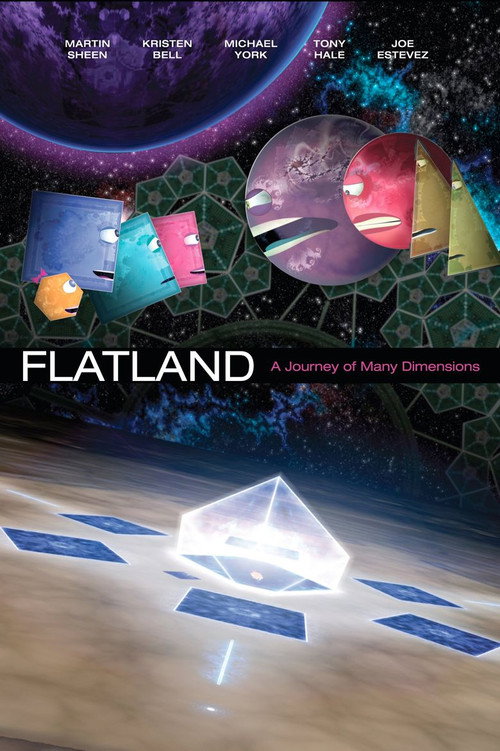
Flatland (2007) poster. Still unanswered: is there a scene after the credits?

Set in a world of only two dimensions inhabited by sentient geometric shapes, the story follows Arthur Square and his ever-curious granddaughter Hex. When a mysterious visitor arrives from Spaceland, Arthur and Hex must come to terms with the truth of the third dimension, risking dire consequences from the evil Circles that have ruled Flatland for a thousand years.

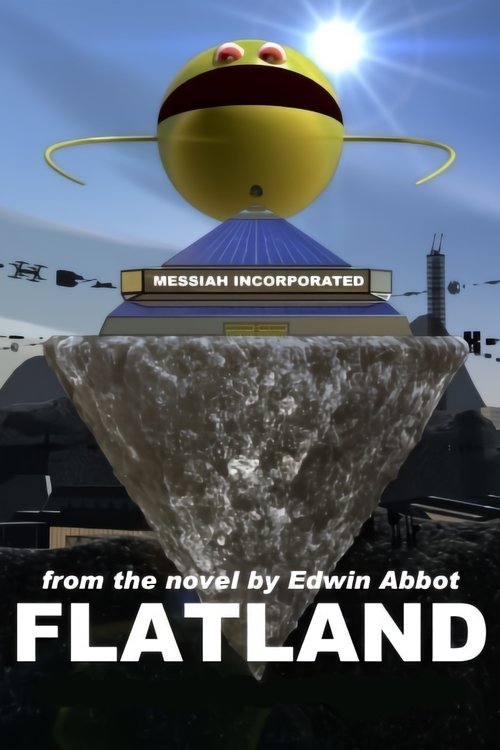
Film poster, Flatland (2007). No post-credit verdict yet.

Flatland is a two-dimensional universe occupied by living geometric figures - squares, triangles, circles, etc. A Square, Attorney At Law, finds himself in the middle of two upheavals: the rise of martial law by the circular leadership of Flatland, and the arrival of A Sphere, CEO Of Messiah, Incorporated, a creature from a hitherto-unknown third dimensional world.

Poster for Cubits (1978), awaiting its first vote.

Jarnow adapts an architectural grid catalogue of cubic rotations in order to explore a direct relationship between animation procedure and logical numerical operations. The film is as much the making of animation as it is a paper model of a computer. The cube sheet, upon which the film is based, is so constructed that a horizontal cubic rotation and a diagonal pan yields a diagonal rotation. Combinations of these primary moves result in more complex rotations throughout this awe inspiring film.

Movie art for CircleSpeak (2005), post-credit scene unknown.

Shot in Southern England over the course of six weeks by a crew of three American filmmakers, CircleSpeak offers a nuanced look at the passions and beliefs of the people immersed in the crop circle phenomenon during the season of 2001. This feature-length documentary presents interviews with serious “researchers”, self-proclaimed “hoaxers”, local farmers and villagers who are all, in one way or another, involved in this strange and compelling summer spectacle taking place year after year.

Cover image for Solving the Bonnet Problem (2023), not yet voted on.

The documentary "Solving the Bonnet Problem" follows the work of three mathematicians as they collaborate to solve a long-standing geometrical problem proposed by Pierre Ossian-Bonnet. Alongside their work, the film explores the lives and contributions of Bonnet and his contemporary Gaston Darboux, as well as the history of French mathematics in the 19th century. Captivating computer graphics help unravel intricate concepts and make them accessible to all.

Movie art for Toroid (2019), post-credit scene unknown.

Toroid is an experimental audio-reactive animation work that demonstrates the possibilities of harnessing digital waveforms of electronic origin into a continual source of power. By making the invisible visible, the work bears similarity and inspiration from the extensive quantum energy research at CERN which seeks to uncover and control the particles in and around us. In this era of over-production and over-algorithmic data illusion of choices, Toroid inserts itself in the digital narrative as a power source simulation showing a possibility for ensuring a positive flow of eternal (renewable) energy working in parallel with the natural order.

Clouds Are Not Spheres (2010). Nobody has said whether there is anything after the credits.

Until recently geometry was 'cold', incapable of describing the irregular shape of a cloud, the slope of a mountain or the beauty of the human body. With fractal geometry, Benoit Mandelbrot gave us a language for our natural world. In this captivating documentary, the man himself explains this groundbreaking discovery.

Cover image for Berra, not yet voted on.

A film about art, mathematics, friendship, and social deprivation. Bertil lives in a decommissioned railway station in Skåne. He is internationally renowned, with monumental works displayed across Sweden, yet to gather the courage to walk to the local grocery store he needs a few glasses of wine under his belt. He is powerful, imaginative, humorous, and a resourceful storyteller. He jokes and performs for those around him whenever the opportunity arises. His sculptures are geometrically and mathematically calculated, and his tools are meticulously organized — but his life can be chaotic. One day, something happens: Bertil’s sculptures have disappeared.

Film artwork for From the Point to the Shape (1954), no verdict on the credits.

Considered to be artist Martin Blaszko's only incursion into film. Through the experimentation with various film techniques, the artist speaks of the laws of geometry which are an important part of his work, and other obsessions of his, such as, bipolarity, the monumental, and the city as a source of aesthetic emotion.

Movie poster for Dimensions (2013), waiting for its first vote.

Nine chapters, two hours of maths, that take you gradually up to the fourth dimension. Mathematical vertigo guaranteed!

Image for Bleeding Humanity (2026), a film with no post-credit data.

Stemming from her adoption, a curious girl navigates who she is and what defines her as human, confronted by her relationship with her sister and an exotic encounter that becomes the catalyst.

Perspectives (1977): nobody has checked the credits yet.

Jarnow regularizes a child's primitive sketch of a house into increasingly firmer architecture, showing how the same place might by rendered by different hands. Objects twist and turn, a drawing resolving into a wall painting, as the perspective shifts, boxes within boxes, until the viewer is back outside

Film artwork for Cube (1979), no verdict on the credits.

A filmed exercise that follows in the path of Rotating Cubic Grid and Cubits, the predictably titled Cube features cubes of varying shapes and size sliding around and growing into and out of one another, demonstrating how multiple parts can make up a whole.

Poster for Tondo (1973), awaiting its first vote.

Tondo introduces the cosmic formalism that was the primary theme of Al Jarnow's independent films. An infinite gridscape alternates with vibrating etchings, spirograms and other surreal realities.

Privacy policy

When you vote, we save your Yes or No answer and when you voted.

We use a cookie and your internet address to recognize your vote on each movie. This prevents repeat votes. The cookie lasts for five years.

Your votes are kept as part of the movie totals.