

Post-apocalyptic survivors find refuge in the Rocky Mountains to hide from giant, insect-like creatures that can't live above 8,000 feet. However, when one of them needs life-saving supplies, they risk it all to venture into the danger zone.
Post-apocalyptic survivors find refuge in the Rocky Mountains to hide from giant, insect-like creatures that can't live above 8,000 feet. However, when one of them needs life-saving supplies, they risk it all to venture into the danger zone.

Record of the 1934 German expedition to Nanga Parbat, led by Willy Merkl and with the full backing of the new Nazi government. Peter Aschenbrenner and Erwin Schneider reached an estimated height of 7,895m on July 6, but were forced to return because of worsening weather. On July 7 they and 14 others were trapped by a ferocious storm at 7,480m. During the desperate retreat that followed, three famous German mountaineers, Uli Wieland, Willo Welzenbach and Merkl himself, and six Sherpas died of exhaustion, exposure and altitude sickness, and several more suffered severe frostbite.

Michel and Cathy, wed for longer than they can remember, lead a quiet but monotonous life in the mountains. When a bear bursts out in front of Michel’s car, accidentally killing two drug dealers and revealing a €2 million loot in the process, their life takes an unpredictable turn, especially when they decide to cover up the incident and keep the money! But their plan leads them to stumble upon an unexplained trail of dead bodies. More used to being honest than crooked, Michel and Cathy’s clumsy cover-up efforts soon put an interfering inspector hot on their trail.

"Bialy Slad" featured as the main characters amateur actors, who were by that time well-known Polish skiers, among them Andrzej, Herr Krzeptowski's brother. The film depicts the story of two orphans, Zoska and Wladek; Zoska is in love with Jasiek, a hunter, but this is an unrequited love because Jasiek loves Hanka, who at the same time is desired by the handsome and strong Andrzej, a mountain climber.

Released in 1930. Direction, production, writing & cinematography by Adam Krzeptowski

Following in the footsteps of Captain John Noel and his immensely popular documentaries taken on the Mount Everest expeditions of the 1920s ("Climbing Mount Everest"/"The Epic of Everest"), Frank Smythe hoped to help finance his 1931 attempt on Kamet, another Himalayan peak, by bringing back film footage of a successful ascent including summit shots which were at that time the highest ever taken in the world.
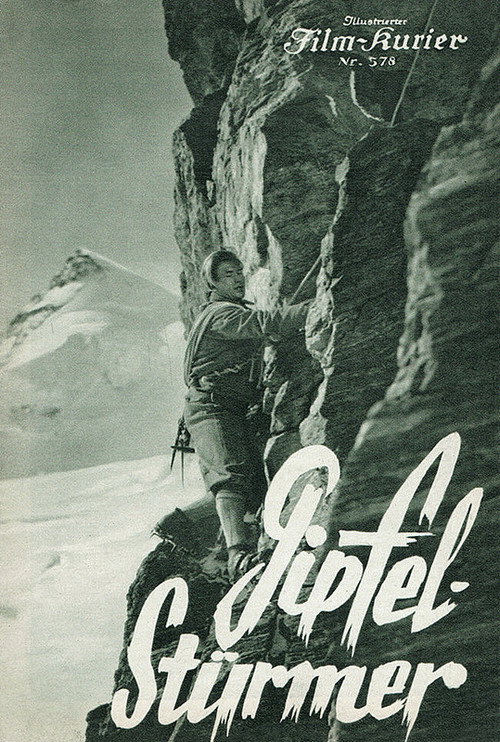
The two unemployed engineers Franzl and Bertl want to be the first to climb the Matterhorn from the dangerous north face. They travel by bicycle with Mizzl and Traudl but without telling them about their intentions. The women accompany them on the assumption that it is a touristical trip. All four camp in a tent at the foot of the Matterhorn and Franzl and Bertl secretly begin the dangerous ascent. The girls will have to follow the ascent together with the residents of the village and the guests of the mountain hotel using binoculars. The role of Franzl is played by Franz Schmid, the actual conqueror of the north face of the Matterhorn together with his brother Toni in 1931.

A young tourist has an accident during a holiday hike in the Tatra Mountains. The romance he begins with the highlander woman who takes care of him leads to tragedy.

Short version of 'Nanga Parbat' (1936), the record of the 1934 German expedition to Nanga Parbat, led by Willy Merkl and with the full backing of the new Nazi government. Peter Aschenbrenner and Erwin Schneider reached an estimated height of 7,895m on July 6, but were forced to return because of worsening weather. On July 7 they and 14 others were trapped by a ferocious storm at 7,480m. During the desperate retreat that followed, three famous German mountaineers, Uli Wieland, Willo Welzenbach and Merkl himself, and six Sherpas died of exhaustion, exposure and altitude sickness, and several more suffered severe frostbite.

Documentary on one of the first editions of the Trofeo Mezzalama, the highest ski mountaineering race in Europe, at more than 4,200 meters above sea level, which takes place on the glaciers of Monte Rosa, from Breuil to Gressoney-La-Trinité, crossing the summits of Castor (4,199 meters) and Nez du Liskamm (4,100 meters). The film recounts the last hours of feverish preparation before the start, the teams preparing for the race linked in ropes, then follows the stages of the competition by following the groups of skiers from a plane. Created in 1933, the Trofeo Mezzalama was contested until 1938, before falling into oblivion during the war. A second version was organized from 1970 to 1973. A third biannual version has been organized since 1997.

The idea is a simple one: three alpinists climb in the Mont Blanc Massif. This situation brings one face to face with the dangers of the mountain: avalanches, crevasses, fog, the climbing of the rocks, roping up, etc. All of this is magnified, transcended by a remarkable and strong use of the language of cinema. One of the first films about high mountains with Roger Frison-Roche and magnificent music by Maurice Jaubert

Once free to farm in the most remote part of the Himalayas, today the people labor on the ambitious road to Zanskar, which will soon connect both sides of their valley. Their days are devoted to breaking rocks with sledgehammers, dynamiting sections of cliffs and smoothing piles of sand and gravel by hand. Along with impoverished laborers from India, they toil endlessly to complete this colossal project designed to modernize the region, and it comes at a huge cost. They’ve already relinquished much of their land and herds to focus on the project, and their lives are filled with uncertainty. They worry about their future when the road is finally finished, and when the world can easily access their region. There will be unexpected freedom and opportunities to live in greater comfort… but the harmonious and delicate balance they’ve achieved over generations - despite the extreme climate - will be lost.

On September 28th, 1903, the Urban Mountaineering Expedition, headed by Frank Ormiston-Smith, left Zermatt to attempt the conquest of the Matterhorn. On the 29th, the conquest was completed by the filming of the panorama from the actual summit of the mountain. The film consists of 20 scenes and illustrates the whole ascent from Zermatt through the Hornli Ridge. A copy of the film was found in Zermatt in 1953 and was was erroneously attributed to Frederick Burlingham and dated 1901. Since then, the film has been widely publicized as the first mountain film under the title of 'Cervin 1901', but this is incorrect. Ormiston previously had made 'Alpine series' (1901), 'The ascent of Mont Blanc' (1902), 'Climbing the Great Schreckhorn' (1902) and 'Ascent of the Jungfrau' (1903). The pictures and descriptions of the Charles Urban Trading 1903 film catalogue show without any doubt that 'Ascent of the Matterhorn' and 'Cervin 1901' are the same film.

Record of the 1937 German Expedition to Nanga Parbat, led by Karl Wien. This was the third German expedition to the mountain, and the team followed the same route than the 1932 and 1934 expeditions, led by Willy Merkl by the Rakhiot Face. During the ascent, progress was made, but more slowly than previous expeditions due to heavy snowfalls. Sometime between 14 and 16 June, Wien was camped with other six German climbers and nine Sherpas at Camp IV, below Rakhiot Peak, when it was overwhelmed by a massive avalanche. All sixteen men were killed in what remains as the worst single disaster ever to occur on an eight thousand meter peak. Uli Luft, Carl Troll and Dawa Thondup, who stood at the base camp, were the only survivors of the German and Sherpa teams respectively. The film shows images of the members of the rescue team, led by Paul Bauer, that arrived one month later.

Your favourite gamer trio is back! This time, Waldek, Staszek and Delfina will spend an adventure-packed summer in the Tatra Mountains. During the trip, Waldek accidentally finds out that his father – the man he has heard so much about from his mum, the person who abandoned his family a long time ago – lives nearby. The boy is determined to find him and ask him about the reasons for his decision. Together with Staszek, under the cover of night, they set out on their mission. The hazards of the mountain trail, however, are nothing compared to what Delfina will have to do. The creative teenager has to hide the truth about the boys’ disappearance from her aunt, the mother of Waldek and… her new partner. How will this secret mission affect the lives of all the characters? Will Waldek find an answer to the questions that haunt him and understand the actions of his father?

Sounded version of the 1928 film 'Der Kampf ums Matterhorn'. The added sound track included music composed by Schmidt-Boelckeb and dubbed dialogs by different actors. This version is slightly shorter than the silent film due to the disappearance of the movie titles. The story, based on the novel by Carl Haensel recreates the struggle between Edward Whymper and Jean-Antoine Carrel for the first successful ascent of the Matterhorn in 1865. In 1938 two new versions of the movie were filmed under the direction of Luis Trenker, who acted again in the role of Carrel. One version was shot in German (Der Berg ruft) and the other in English (The Challenge).

Epic documentary about the German expeditions to Nanga Parbat up to 1937. After a first unsuccessful attempt in 1932 and the tragic second expedition led by Willy Merkl in 1934, in 1937 Karl Wien led another expedition to the mountain following the same route as Merkl's expeditions. Progress was made, but more slowly than before due to heavy snowfall. About 14 June seven Germans and nine Sherpas, almost the entire team, were at Camp IV below Rakhiot Peak when it was overrun by an avalanche. All sixteen men died. The film was assembled in 1938 with rescued 16mm material shot during the 1937 attempt and footage from the previous expeditions.

A ruthless Roman emperor discovers a secluded Druid stronghold in the mountains of Caledonia, the last remnant of the mystical tribe. When the imperial legions threaten to annihilate the ancient civilization, a peaceful Celtic elder is forced to betray his vow of pacifism and to take up arms to defend his family from the inexorable advance of the Empire in a clash that will decide the fate of an entire culture.

At a time where there were no alarm-clocks, an old men worked as an awaker. Every day he walked the long way from his house to the village until he gets an old shiny bell.

The film was produced by Jerome Hill as 'a document of skiing according to the principles of Hannes Schneider.' It features Otto Lang, director of the Mt Rainier and Mt Baker ski schools. As the film opens, Otto emerges from a cabin beneath Table Mountain at the Mt Baker ski area with his canine friend. He applies wax-on climbing skins to his skis. Then he steps into his bindings and climbs to a scenic ridge. The narrator describes each technique in detail as Otto demonstrates again. Several of the maneuvers are done in slow motion on a slope meticulously packed by side-stepping.