Post-credit scenes: results for “tag: talkie”

Poster for Nanga Parbat (1936), blank on post-credit scenes.

Record of the 1934 German expedition to Nanga Parbat, led by Willy Merkl and with the full backing of the new Nazi government. Peter Aschenbrenner and Erwin Schneider reached an estimated height of 7,895m on July 6, but were forced to return because of worsening weather. On July 7 they and 14 others were trapped by a ferocious storm at 7,480m. During the desperate retreat that followed, three famous German mountaineers, Uli Wieland, Willo Welzenbach and Merkl himself, and six Sherpas died of exhaustion, exposure and altitude sickness, and several more suffered severe frostbite.

The Fight for the Matterhorn (1934) cover. Nothing recorded about its credits.

Sounded version of the 1928 film 'Der Kampf ums Matterhorn'. The added sound track included music composed by Schmidt-Boelckeb and dubbed dialogs by different actors. This version is slightly shorter than the silent film due to the disappearance of the movie titles. The story, based on the novel by Carl Haensel recreates the struggle between Edward Whymper and Jean-Antoine Carrel for the first successful ascent of the Matterhorn in 1865. In 1938 two new versions of the movie were filmed under the direction of Luis Trenker, who acted again in the role of Carrel. One version was shot in German (Der Berg ruft) and the other in English (The Challenge).

Film poster, Dead Echo (1934). No post-credit verdict yet.

A young tourist has an accident during a holiday hike in the Tatra Mountains. The romance he begins with the highlander woman who takes care of him leads to tragedy.

Key art for High Hazard (1935), unanswered on the post-credit question.

Britain's first complete rock climbing film, by Stanley Watson. A film about climbing in the Lakes. Norah Johnstone, a teacher at Keswick Grammar School and later Watson's wife, starred as a Victorian climber. The film includes footage of Stanley Watson himself climbing Kern Knotts blindfolded and a young girl, Vivian Verity, whose first climb at aged 9 was up Napes Needle. Stanley Watson is a keystone in the history of British climbing. He established the British Mountain Guides Organisation in 1930.

Battle for the Himalaya (1938) poster. The count is still zero.

Epic documentary about the German expeditions to Nanga Parbat up to 1937. After a first unsuccessful attempt in 1932 and the tragic second expedition led by Willy Merkl in 1934, in 1937 Karl Wien led another expedition to the mountain following the same route as Merkl's expeditions. Progress was made, but more slowly than before due to heavy snowfall. About 14 June seven Germans and nine Sherpas, almost the entire team, were at Camp IV below Rakhiot Peak when it was overrun by an avalanche. All sixteen men died. The film was assembled in 1938 with rescued 16mm material shot during the 1937 attempt and footage from the previous expeditions.

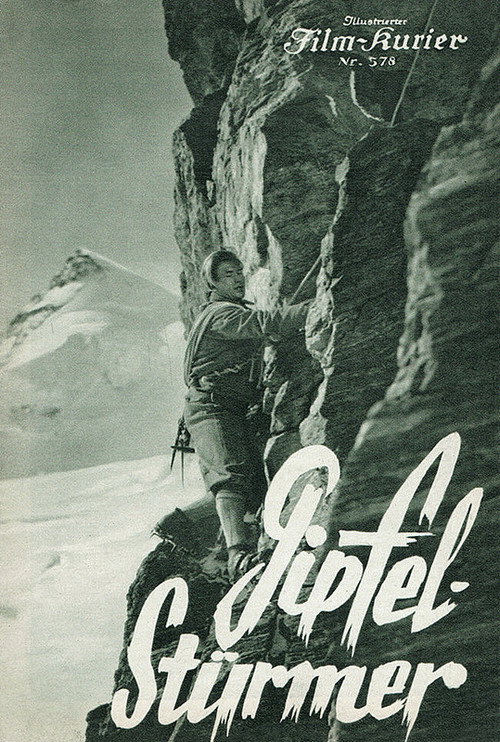
The Peak Scaler (1933): nobody has checked the credits yet.

The two unemployed engineers Franzl and Bertl want to be the first to climb the Matterhorn from the dangerous north face. They travel by bicycle with Mizzl and Traudl but without telling them about their intentions. The women accompany them on the assumption that it is a touristical trip. All four camp in a tent at the foot of the Matterhorn and Franzl and Bertl secretly begin the dangerous ascent. The girls will have to follow the ascent together with the residents of the village and the guests of the mountain hotel using binoculars. The role of Franzl is played by Franz Schmid, the actual conqueror of the north face of the Matterhorn together with his brother Toni in 1931.

Film poster, Deutsche Eisenbahner im Kampf um den Nanga Parbat (1935). No post-credit verdict yet.

Short version of 'Nanga Parbat' (1936), the record of the 1934 German expedition to Nanga Parbat, led by Willy Merkl and with the full backing of the new Nazi government. Peter Aschenbrenner and Erwin Schneider reached an estimated height of 7,895m on July 6, but were forced to return because of worsening weather. On July 7 they and 14 others were trapped by a ferocious storm at 7,480m. During the desperate retreat that followed, three famous German mountaineers, Uli Wieland, Willo Welzenbach and Merkl himself, and six Sherpas died of exhaustion, exposure and altitude sickness, and several more suffered severe frostbite.

Mountain Man (1934) poster. The count is still zero.

The mountain guide Jakob is a controversial figure. His supposed father dies and leaves behind a great heritage to the people. In the town they consider Jakob a bastard, because his parents were not married, which means that without a testament, the lands in which he lives do not belong to him. But the testament indicates that the inheritance corresponds him under a single condition, he must be the first person to climb the east face of Monte Verità. French version of Die weisse majestat, shot the year before in German with the same script in the Eiger/Jungfrau region but with different actors and by a different director.

White Marathon (1935) poster. Still unanswered: is there a scene after the credits?

Documentary on one of the first editions of the Trofeo Mezzalama, the highest ski mountaineering race in Europe, at more than 4,200 meters above sea level, which takes place on the glaciers of Monte Rosa, from Breuil to Gressoney-La-Trinité, crossing the summits of Castor (4,199 meters) and Nez du Liskamm (4,100 meters). The film recounts the last hours of feverish preparation before the start, the teams preparing for the race linked in ropes, then follows the stages of the competition by following the groups of skiers from a plane. Created in 1933, the Trofeo Mezzalama was contested until 1938, before falling into oblivion during the war. A second version was organized from 1970 to 1973. A third biannual version has been organized since 1997.

Devil of the Matterhorn (1932). Nobody has said whether there is anything after the credits.

English-language, dubbed sound and partly re-edited version of Der Kampf ums Matterhorn. During an early, unsuccessful attempt at climbing the Matterhorn, Edward Whymper finds himself rescued by an italian guide, Jean Antoine Carrel. The two men quickly build a friendship and agree to reach the peak together. However, local villagers plot to divide the alliance of Whymper and Carrel and both men join rival teams as they set out in a race to conquer the mountain. A mountaineering drama based on the novel by Carl Haensel and inspired in the dramatic true story of Edward Whymper, who led the first successful ascent of the Matterhorn in 1865.

Three Lives and a Rope (1934). Nobody has said whether there is anything after the credits.

The idea is a simple one: three alpinists climb in the Mont Blanc Massif. This situation brings one face to face with the dangers of the mountain: avalanches, crevasses, fog, the climbing of the rocks, roping up, etc. All of this is magnified, transcended by a remarkable and strong use of the language of cinema. One of the first films about high mountains with Roger Frison-Roche and magnificent music by Maurice Jaubert

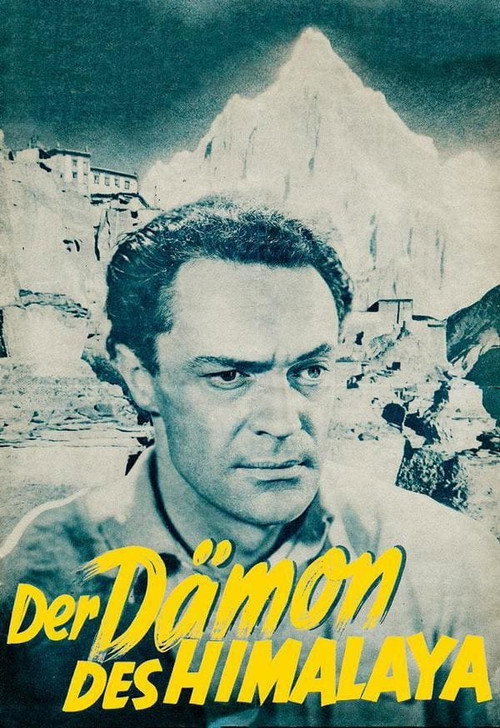
Key art for Demon of the Himalayas (1935), unanswered on the post-credit question.

German film about a Himalayan expedition and the search for a mountain spirit, who guarded, according to the tradition of the locals, the peaks of high mountains. The long-lost and recently rediscovered and restored film is now a unique cinematic document because it is the first feature film that was shot directly in the Himalayas (up to 6400 m altitude). Hans Ertl even turned his Bell & Howell to the main summit of Sia Kangri, 7422m. Likewise, the film contains footage from India and Tibet, from a time long before the emergence of mass tourism. Some of the footage was later recycled in ‘Lost horizon’ (1937) by Frank Capra and in ‘Storm over Tibet’ (1952).

Film poster, Pointed Heels (1929). No post-credit verdict yet.

Fay Wray plays a beautiful showgirl who falls for a rich Park Avenue guy played by Phillips Holmes. William Powell is a producer in love with Miss Wray, but he won't use his influence to take any advantage... as usual, he's a perfect gentleman.

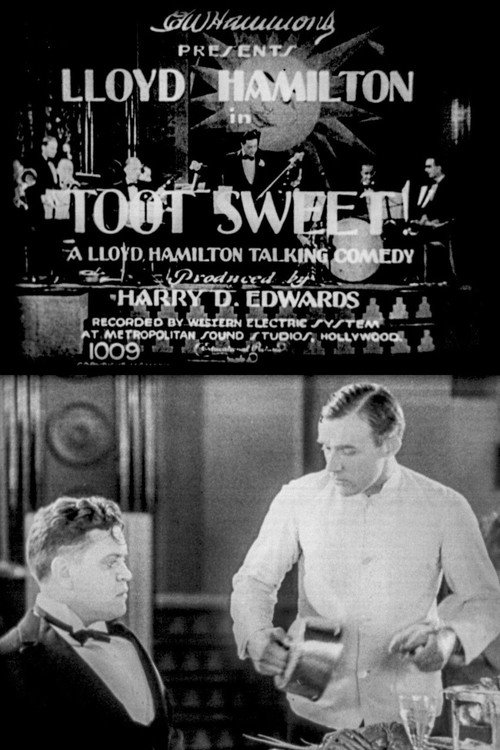
Key art for Toot Sweet! (1929), unanswered on the post-credit question.

Ham is interested in a girl named Marie and wants to impress her. First he buys a car and then he takes her out to a swanky nightclub. During the course of this disastrous date Ham realizes that Marie isn't the nice girl he thought she was: she only went out with him to make her real boyfriend jealous. The boyfriend is a dancer at the club, and when she sees him kissing his dance partner she becomes enraged and smashes up the place, while poor Ham is stuck with the bill.

Gang War (1928) poster image. Zero votes so far.

Saxophone player Clyde meets a woman named Flowers, and teaches her to dance. He later discovers that gangster boss "Blackjack" is also in love with her. "Blackjack" is also battling gang boss Mike Luego in a violent turf war.

Poster for Sal of Singapore (1928), awaiting its first vote.

SAL OF SINGAPORE was nominated for an Oscar for achievement in Writing during the second year of the Academy Awards. The film, being a part-talkie, nearly disappared from view. However, a preservation print does exist at UCLA, although it is unavailable for public viewing, awaiting restoration.

Poster, Love Letters from the Engadine (1938). Nobody has voted on this one.

Constance, the young widow of a wealthy American, gets a love letter from the Engadine region, signed by the famous guide Toni Anewater she had met during a holiday in the previous year. Constanze and her friend Dorothy therefore go to Switzerland for winter sports. But identical love letters to other ladies in London, Paris and Rome have been sent. Toni does not know anything about the letters. Everything seems to be a cunning of the hotel owner to attract tourists.

The Challenge (1938) poster. Still unanswered: is there a scene after the credits?

During an early, unsuccessful attempt at climbing the Matterhorn, Edward Whymper finds himself rescued by an italian guide, Jean Antoine Carrel. The two men quickly build a friendship and agree to reach the peak together. However, local villagers ploto to divide the alliance of Whymper and Carrel and both men join rival teams as they set out in a race to conquer the mountain. A mountaineering drama based on the novel by Carl Haensel and inspired in the dramatic true story of Edward Whymper, who led the first successful ascent of the Matterhorn in 1865. There is another version of the film titled Der Berg Ruft, shot the same year in German.

Privacy policy

When you vote, we save your Yes or No answer and when you voted.

We use a cookie and your internet address to recognize your vote on each movie. This prevents repeat votes. The cookie lasts for five years.

Your votes are kept as part of the movie totals.