

A black-and-white visual meditation of wilderness and the elements. Wildlife filmmaker Richard Sidey returns to the triptych format for a cinematic experience like no other.
A black-and-white visual meditation of wilderness and the elements. Wildlife filmmaker Richard Sidey returns to the triptych format for a cinematic experience like no other.

"Jordan Lisi's got some great ideas about structure here, which he's taken off and run with, hard--the result is this tough little jewel of indie cinema." - Andrew Bujalski

An homage to Len Lye and Jules Engel, Terra Incognita is a hand-drawn animated abstraction in three parts.

Three intersecting stories of transgender romance explore the boundaries of love, culture and identity across three generations.

Maniac Summer consists of images and sounds recorded in Paris in the summer of 2009. It is a sprawling triptych without a beginning or end and with no specific subject or topic. The camera is positioned in front of a window and left running. It observes movements, registers noises coming from the street or nearby park, captures Chantal Akerman going about her business in her apartment: smoking, working, talking on the telephone. Fragments from the artist’s everyday life are featured in the installation’s central video, while the adjoining panels are more symbolically charged; in them, various images from the former have been isolated, modified and repeated. These abstract afterimages act as a kind of memory, looking back to the images in the installation’s centrepiece as so many shadows of its reality.

A non-verbal visual journey to the polar regions of our planet portrayed through a triptych montage of photography and video. Landscapes at the World's Ends is a multi-dimensional canvas of imagery recorded above the Arctic Circle and below the Antarctic Convergence, viewed through the lens of whom is realistically an alien in this environment, the polar tourist. Filmed during several artist residencies on-board three expedition vessels, New Zealand nature photographer and filmmaker Richard Sidey documents light and time in an effort to share his experiences and the beauty that exists over the frozen seas. Set to an ambient score by Norwegian Arctic based musician, Boreal Taiga, this experimental documentary transports us to the islands of South Georgia, the Antarctic Peninsula, Greenland and Svalbard. Landscapes at the World's Ends is the first film in Sidey's Speechless trilogy, and is followed by Speechless: The Polar Realm (2015) and Elementa (2020).

Inspired by Ballet Mécanique, Ballet Biologic is an experimental triptych exploring the body through movement, physical painting and spoken testimony. Made alongside three physical paintings and exhibited at LJMU’s Umwelt exhibition at Bridewell Studios in Liverpool, the project turns vulnerability into rhythm, image and reclamation.

A three-part love story: Alborada, Cénit y Ocaso (Sunrise, Noon and Sunset). A dying prince (Agüeros) lives a stormy love affair with a "femme fatale" (Padilla) who doesn't care for his feelings.

Three women’s lives intersect in a small town in Uzbekistan following the Second World War. The first, an old woman trapped in a forced marriage; the second, a schoolteacher intent on imposing progress on the remote region; the third, a young woman determined to build her own house without her husband’s or the state’s approval.
Dying for the Other is a video triptych, documenting the lives of mice used in breast cancer research and humans suffering from the same disease. In order to produce this video, da Costa documented scenes of her own life during the summer of 2011 and combined them with footage taken at a breast cancer research facility in New York City over the same time frame.

Philippe de Montebello, Director of The Metropolitan Museum of Art from 1977 to 2008, guides viewers through The Cloisters, pointing out Romanesque and Gothic architecture and artwork, beautiful tapestries, and the diverse species in the gardens. He outlines the history of the building and it's many influences and highlights significant works of art in the collection. It was produced in 1989 by The Metropolitan Museum of Art's Office of Film and Television.
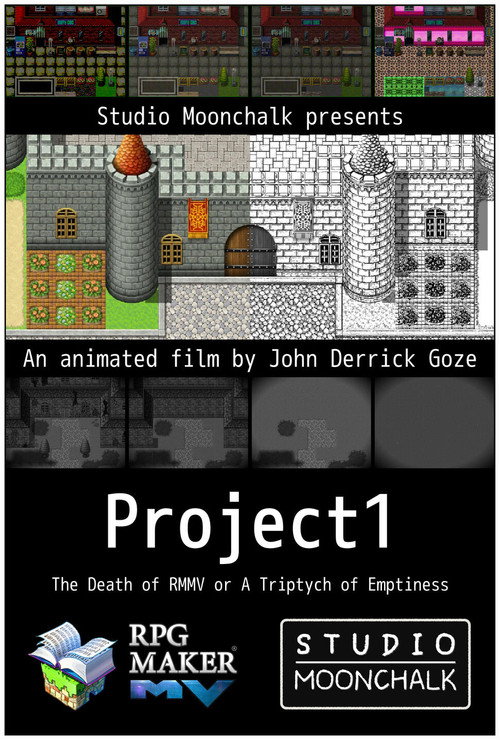
A three-hour "near" animated triptych film made entirely with RPG Maker MV engine, divided into three segments with different film formats in reverse chronological order. Each segments depicted with "emptiness like a ghost town", shifting every scenes into unusual, surrealistic imagery.