Post-credit scenes: results for “tag: zagreb”

Poster for From Russia with Love (1963). No votes yet on whether it has a post-credit scene.

Agent 007 is back in the second installment of the James Bond series, this time battling a secret crime organization known as SPECTRE. Russians Rosa Klebb and Kronsteen are out to snatch a decoding device known as the Lektor, using the ravishing Tatiana to lure Bond into helping them. Bond willingly travels to meet Tatiana in Istanbul, where he must rely on his wits to escape with his life in a series of deadly encounters with the enemy.

Poster for Pescenopolis (2003). Never been answered.

Pescenica is an old industrial suburb of Zagreb. As a satirical depiction of Croatia's recent politics, it has been declared independent republic. What's it like there today? Over a year, the film crew was combing streets, avenues, parks and backyards, focusing on the lives of four Pescenica inhabitants: its self-proclaimed president, a teacher in a Roma school, a cleaning lady in a film distribution company and a young stage director. All that in order to portray Pescenopolis, the film's protagonist that floats between mud and clouds.

Key art for Nausicaa (1995), unanswered on the post-credit question.

Nazi-occupied Croatia, 1941. A young university student named Matija Remenar moves from his small provincial town to Zagreb. During his stay, he notices a beautiful woman in the window across the street from his apartment, falling head over heals for her. He names this woman Nausicaa, after the eponymous character from Homer's Odyssey. Things complicate, however, when he becomes involved in an active suicide investigation of the three tennants who had rented the apartment prior to him. Not only that, but the apartment's original owner, middle-aged mrs. Šlajner, seemingly becomes infatuated with him, despite the huge age gap.

One Song a Day Takes Mischief Away (1970) poster. Still unanswered: is there a scene after the credits?

Set in pre-World War II Zagreb, the story is seen through the eyes of 6-year-old Perica Šafranek (played by Tomislav Žganec). A dandy from Zagreb, Mr Fulir (played by Relja Bašić), starts flirting with Perica's mother during a family picnic. At first, Perica's father doesn't notice anything, but wants to marry off Perica's aunt, so he invites the man to their residence. After multiple rendezvous, Perica's father becomes aware of Fulir's attempts to seduce his wife.

Movie art for Fine Dead Girls (2002), post-credit scene unknown.

Iva and Marija, a young lesbian couple, rent an apartment in Zagreb, in a building that seems to provide a quiet and safe environment for their love, but over time the atmosphere in the building becomes more and more threatening. The elder landlady Olga dominates the building. Other tenants include her calm husband, her grown-up son Daniel who has a crush on Iva, the prostitute Lidija, an abused housewife, a widower keeping the corpse of his newly deceased wife, a gynecologist performing abortions in one flat of the house, and an ex-soldier who regularly plays martial music at night. After Olga finds out that Iva and Marija are lesbians, the situation escalates .

The Witch of Gric (1920). Nobody has said whether there is anything after the credits.

A young countess, Nera Keglević, is fighting against believing in witches by using witchcraft. But the problem is that local judge Krajačić is accusing Nera to be witch for revenge.

Film poster, The Concert (1954). No post-credit verdict yet.

Celebrating the end of World War II and liberation of their city, a group of students is set on holding a cultural evening. They invite Ema, a reclusive piano teacher from the same building, to play for them. Ema declines, but starts reminscing back on her own life and the historical events that have seemingly overshadowed it.

Happiness (1976) poster. The count is still zero.

This is the story of a poor fisherman, who was looking for and wanted happiness. A quiet family life, filled with the love and care of a woman, was not enough for happiness. Happiness is luxury, wealth... thought the fisherman.

Poster for Operation Stadium (1977), awaiting its first vote.

This movie tells a true story about events in Zagreb in 1941. Nazis and their collaborators organized the great gathering of students on Dubrava stadium. The intention was to publicly separate Jews from them which would lead to future pogrom. The event, however, took an unexpected turn.

High Voltage (1981) poster. Still unanswered: is there a scene after the credits?

After WW II many young people arrive to Zagreb, among them a young worker Sonja Kacar. She is supposed to participate in the construction of the first generator in the Rade Koncar factory. Because there aren't enough experts and materials in Yugoslavia, the factory counts on help from fellow communist countries, Czechoslovakia and Soviet Union. However, after the Inform Bureau's resolution this help is no longer available. Sonja experiences a great intimate disappointment because Stjepan, who she is in love with, supports Stalin.

Poster for The Story of Zagreb Comics: New Square (2017). No votes yet on whether it has a post-credit scene.

Documentary about "New Square", a group of young cartoonists from Zagreb who mainly gathered around the weekly paper Sloga in the second half of the 1970s. The authors Radovan Devlić (1950-2000), Krešimir Skozret (1951-) Joško Marušić (1952-), Mirko Ilić (1956-), Krešimir Zimonić (1956-) and Igor Kordej (1957-) introduced graphic innovations that raised the general interest in the Croatian comic art.

Sleep Sweet, My Darling (2005) poster image. Zero votes so far.

Zagreb, 1941. A young Tomica Škrinjar grows up on the streets of the Trešnjevka neighborhood, blissfully unaware of the brewing war on the far off frontlines. Whilst Tomica is busy developing his first crushes and playing in the sandlofts, his parents decide to hide away an Italian fascist deserter, his aunt Nadica starts a whirlwind romance with a German soldier and the military conflicts between the communist partisans and the Croatian pro-nazi militia reach their doorstep.

The Ceremony (1965) poster. The count is still zero.

Six people are grouped in front of a wall as if for a photograph. The entire ceremony is supervised by a seventh person, who, like a photographer, looks at the group from different angles and rearranges the group by hand-signals.

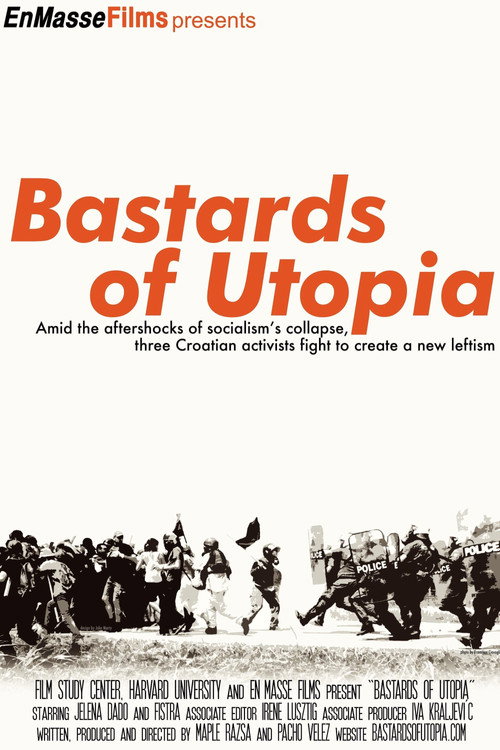
Bastards of Utopia (2010) poster. The count is still zero.

Three Croatian activists struggle to change the world. As children, they lived through the violent collapse of Yugoslavia. But now, amid the aftershocks of socialism's failure, they fight in their own way for a new leftism. In the middle of the struggle, a skeptical American is won over by their cause and even goes to jail with them. The activists, whether clashing with police or squatting in an old factory, risk everything to live their politics. But as the setbacks mount, will they give up the fight? The film, shot during years of fieldwork with a Croatian anarchist collective, applies EnMasseFilm's unique blend of observation, direct participation and critical reflection to this misunderstood political movement. Its portrayal of activism is both empathetic and unflinching -- an engaged, elegant meditation on the struggle to re-imagine leftist politics and the power of a country's youth.

Poster for Zagreb in a Metropolitan Light (1934). No votes yet on whether it has a post-credit scene.

A documentary about Croatia's capital aspirations of becoming metropolis. Camera follows everyday life of random city-goers. Title cards bring interesting plot twists, indeed making this film a mockumentary. One of the earliest preserved pieces of cinema in Croatia.

Cover image for Wings to Yugoslavia (1964), not yet voted on.

A 1964 Pan American travel documentary exploring Yugoslavia's cities, landscapes, culture, and traditions. The film showcases destinations including Belgrade, Sarajevo, Mostar, Dubrovnik, Split, Zagreb, and the Adriatic coast, offering a colorful glimpse of the country during the Cold War era.

Privacy policy

When you vote, we save your Yes or No answer and when you voted.

We use a cookie and your internet address to recognize your vote on each movie. This prevents repeat votes. The cookie lasts for five years.

Your votes are kept as part of the movie totals.